
A home may be worth $450,000 today but have been worth $325,000 several years ago. Both figures could be credible opinions of value for the same property. The difference may have little to do with the accuracy of either appraisal. Instead, it may reflect one of the most important elements of a real estate valuation: the effective date.
For inherited real estate, estate administration, and other situations involving historical property values, understanding the distinction between date-of-death value and current market value is essential.
What Is the Effective Date of an Appraisal?
Every real estate appraisal is developed with an effective date of value. The effective date identifies the point in time to which the appraiser's opinion applies. A current appraisal generally reflects the property's value as of a recent date. A retrospective appraisal reflects its value as of a specified date in the past.
For example, an appraisal prepared in October 2026 might have an effective date of June 15, 2021. Although the appraiser completes the assignment in 2026, the value opinion applies to June 15, 2021. The date the report is written and the effective date of the valuation are therefore not necessarily the same.
This distinction is particularly important when a property valuation is needed for estate-related purposes.
Why the Same Home Can Have Different Values
Real estate values are not fixed.
A property's value reflects market conditions and property characteristics associated with a particular point in time.
Several factors may change between two valuation dates:
Buyer demand: The number of buyers competing for available homes can rise or fall.
Mortgage interest rates: Changes in borrowing costs can affect purchasing power and demand.
Housing inventory: The supply of competing properties can influence prices.
Neighborhood conditions: Development, local amenities, and other market influences may change.
Property condition: Renovations, deterioration, and deferred maintenance can affect value.
These factors do not necessarily move together, and their influence varies by property and market. As a result, an appraisal with a historical effective date may produce a substantially different conclusion from an appraisal of the same property today. Neither value is automatically more accurate simply because it is higher, lower, or more recent. Each must be evaluated in relation to its own effective date and the evidence supporting it.
An Example: One Property, Two Valuation Dates
Consider a hypothetical residence in Metro Atlanta. The homeowner died in June 2021. At that time, the property was in average condition and had not undergone major renovations. In 2026, the heirs are preparing to sell the property. They obtain a current appraisal indicating a market value of $485,000. However, their CPA also needs documentation of the property's value as of the owner's date of death. A retrospective appraisal produces an opinion of $365,000 as of June 2021.
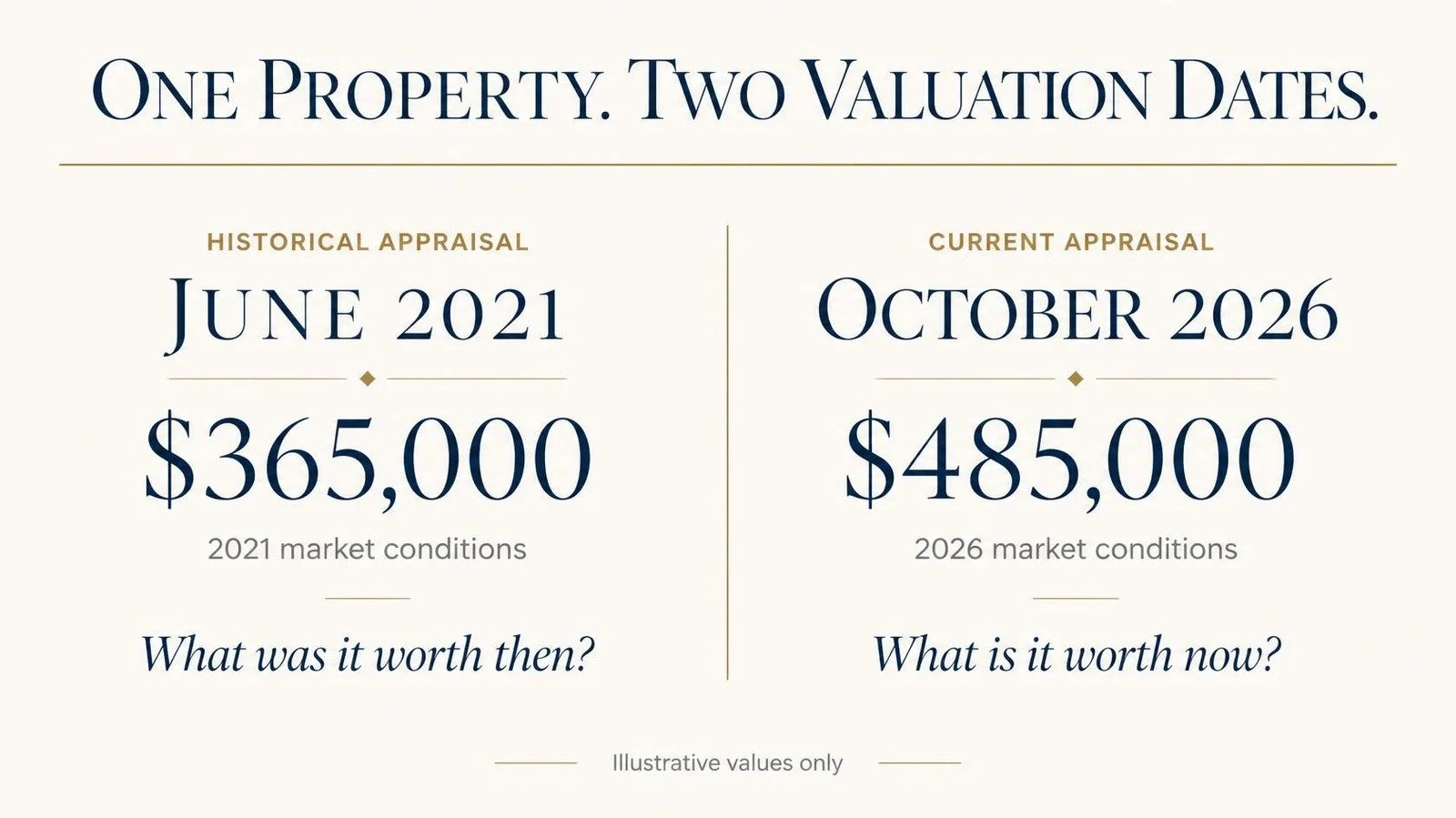
The $120,000 difference does not mean one appraiser made a mistake. It means the two assignments answer different questions. The historical appraisal addresses the property's value at the earlier date. The current appraisal addresses its value in the present market.
Why a Current Appraisal Cannot Simply Replace a Date-of-Death Appraisal
A current appraisal can be useful when an owner is considering a sale, evaluating a property transaction, or seeking an opinion of present market value. However, a current value conclusion does not automatically answer a question about the property's worth several years earlier.
Suppose a family needs a valuation as of September 2020 but obtains an appraisal with an effective date in 2026. Even if the current appraisal is well supported, it does not establish the property's fair market value in September 2020. The assignment would need to address the appropriate historical date. This is why the intended use of an appraisal should be discussed before the work begins. A report developed for the wrong effective date may not provide the information needed by the CPA, attorney, executor, or other intended user.
What If the Home Has Not Changed?
A common question is whether the value should remain the same if the house itself has not changed.
Not necessarily.
Even if the property has the same floor plan, finishes, and physical condition, the surrounding real estate market may have changed significantly. Imagine a home that has received no major improvements over five years. During that period, the local market may have experienced changes in mortgage rates, housing supply, employment conditions, and buyer preferences. Those changes can influence what buyers would have paid for the property at different times. The property may be physically similar, but the market in which it competes is not necessarily the same.
Property value depends on both the real estate and the market conditions associated with the effective date.
What If the Home Has Been Renovated?
Changes to the property introduce another important distinction. Suppose a residence was inherited in 2022 and substantially renovated in 2024. The improvements included a remodeled kitchen, updated bathrooms, and a finished basement. A current appraisal may consider those improvements as part of the property's present condition. A date-of-death appraisal with a 2022 effective date must address the property as it existed at that earlier time. The later renovations cannot simply be treated as though they were already present. Similarly, deterioration occurring after the historical date should not automatically be attributed to the property's earlier condition. The goal is not to estimate what the home would be worth today without renovations. It is to develop an opinion of what the property was worth on the specified historical date. Those are different valuation questions.
Does the Date of Death Always Determine the Required Value?
Not in every circumstance.
The appropriate valuation date depends on the purpose of the assignment and the applicable legal or tax requirements.
For many inherited-property situations, the date of death is relevant because federal tax rules generally reference fair market value at death when determining the basis of property acquired from a decedent, subject to exceptions.
Certain estate-tax circumstances may involve an alternate valuation date or other requirements.
A CPA or attorney should identify the applicable tax or legal requirements and communicate the appropriate valuation date to the appraiser.
The appraiser's responsibility is to develop a credible opinion of real estate value as of the effective date established for the assignment.
This separation of responsibilities helps ensure that the appraisal addresses the correct question without substituting for tax or legal advice.
Why the Correct Date Matters Before Ordering an Appraisal
An appraisal is most useful when its effective date, intended use, and scope align with the client's actual needs.
Before requesting an appraisal, it helps to clarify:
What is the appraisal being used for?
Is a current or historical value needed?
If historical, what is the exact effective date?
Who will rely on the report?
Has a CPA or attorney identified any specific valuation requirements?
For example, an executor preparing to sell a property may need a current valuation for one purpose and a historical valuation for another.
In some situations, both opinions may be useful.
However, they should not be treated as interchangeable simply because they concern the same home.
Understanding the Value Question
The most important distinction is straightforward:
Current market value asks what the property is worth now.
Date-of-death value asks what the property was worth on a specific date in the past.
Both can be developed through professional appraisal practice, but each requires an analysis appropriate to its effective date.
Understanding that difference helps property owners, executors, CPAs, and attorneys request the valuation that actually addresses their needs.
Residential Appraisals for Current and Historical Valuation Needs
Trusted Values Real Estate Appraisal Services provides independent residential appraisals throughout Metro Atlanta, including retrospective valuations for estate-related purposes.
Whether an assignment requires a current opinion of value or a valuation as of a historical date, the effective date is a fundamental part of defining the appraisal.
If you need an appraisal for inherited real estate, estate administration, or another valuation purpose, contact Trusted Values to discuss the property, intended use, and appropriate effective date.
Learn more at TrustedValues.com.
This article is for general educational purposes and does not constitute tax or legal advice. A qualified CPA or attorney should determine the valuation date and tax or legal requirements applicable to a particular situation.