
If you have received notice of a Board of Equalization hearing, it is completely normal to feel uneasy about it. The good news is that most hearings are more structured than an ordinary conversation, but much less intimidating than a courtroom. In most cases, the hearing is simply a chance for you and the county to explain your positions, answer questions, and let a neutral panel decide what value is better supported.
For Georgia homeowners, it helps to think of the process this way: a Board of Equalization hearing is not a punishment and it is not a trap. It is part of the appeal system. If your case reaches this stage, you are being given an opportunity to present evidence, explain the facts of your property, and have your appeal heard.
While procedures can vary somewhat from county to county, the overall process is similar across Georgia. Below is a plain-English overview of what the Board of Equalization is, who is usually in the room, what typically happens during the hearing, what preparation tends to help, and what usually happens after it ends.
What is the Board of Equalization?
In plain English, the Board of Equalization, often called the BOE, is a local panel that hears certain property tax appeals. In Georgia, these boards are generally made up of trained local citizens rather than judges. Their job is to listen to the evidence presented by the homeowner and the county, then decide issues such as value, uniformity, taxability, or exemptions.
For most homeowners, the key point is simple: the Board of Equalization is there to review whether the county’s assessment is properly supported. It is not there to debate whether property taxes feel too high in general, and it is not a place where broader complaints about tax policy usually matter. The focus is on the property and the evidence.
If you are new to the appeal process, our article “Georgia Property Tax Appeals: What Homeowners Should Know” provides the broader overview, and our article “Georgia Property Tax Appeal Deadlines” explains the timing rules that usually control how a case gets to this stage.
Who is usually at the hearing?
The exact setup can differ by county, but most hearings involve a fairly small group of people. Usually, you can expect to see the Board members, a clerk or hearing administrator, a representative from the county assessor’s office, and the homeowner or the homeowner’s authorized representative.
If you hire someone to assist you, that person may also appear on your behalf, subject to the county’s notice requirements. In some cases, witnesses may be involved as well, such as an appraiser, contractor, or another person with relevant knowledge about the property.
That sounds formal, and to a point it is. But the atmosphere is usually closer to a structured meeting than a courtroom trial. People are typically seated around a table or in a hearing room, everyone takes turns speaking, and the Board members ask questions when they need clarification.
What usually happens at the hearing?
Although each county may handle details a little differently, the general rhythm of a Georgia BOE hearing tends to be straightforward.
1. The hearing is opened The clerk or chair usually identifies the property and the parties, explains the purpose of the hearing, and may review basic rights or procedures. Participants may be sworn in before giving testimony.
2. One side presents first In many hearings, either the homeowner or the county will be allowed to go first. The first side explains its value position and presents supporting documents, photographs, comparable sales, or other evidence.
3. The other side responds The second side then presents its own evidence and explanation. In a typical residential appeal, this often means the county explains how it arrived at its value, and the homeowner explains why that value appears too high or otherwise unsupported.
4. Questions may be asked Board members may ask questions about comparable sales, condition issues, square footage, repairs, site influences, or other facts that affect value. The goal is usually to clarify the record, not to intimidate the homeowner.
5. The Board reaches a decision In many cases, the Board announces its decision at the end of the hearing or shortly thereafter in writing. Counties may differ on how quickly the written notice arrives, but the hearing itself usually ends once the Board has what it needs to make a decision.
Most residential hearings are not especially long. Many are measured in minutes rather than hours. That does not mean they are unimportant. It simply means the Board is usually looking for a focused presentation of the most relevant facts, not a long speech.
What should a homeowner bring?
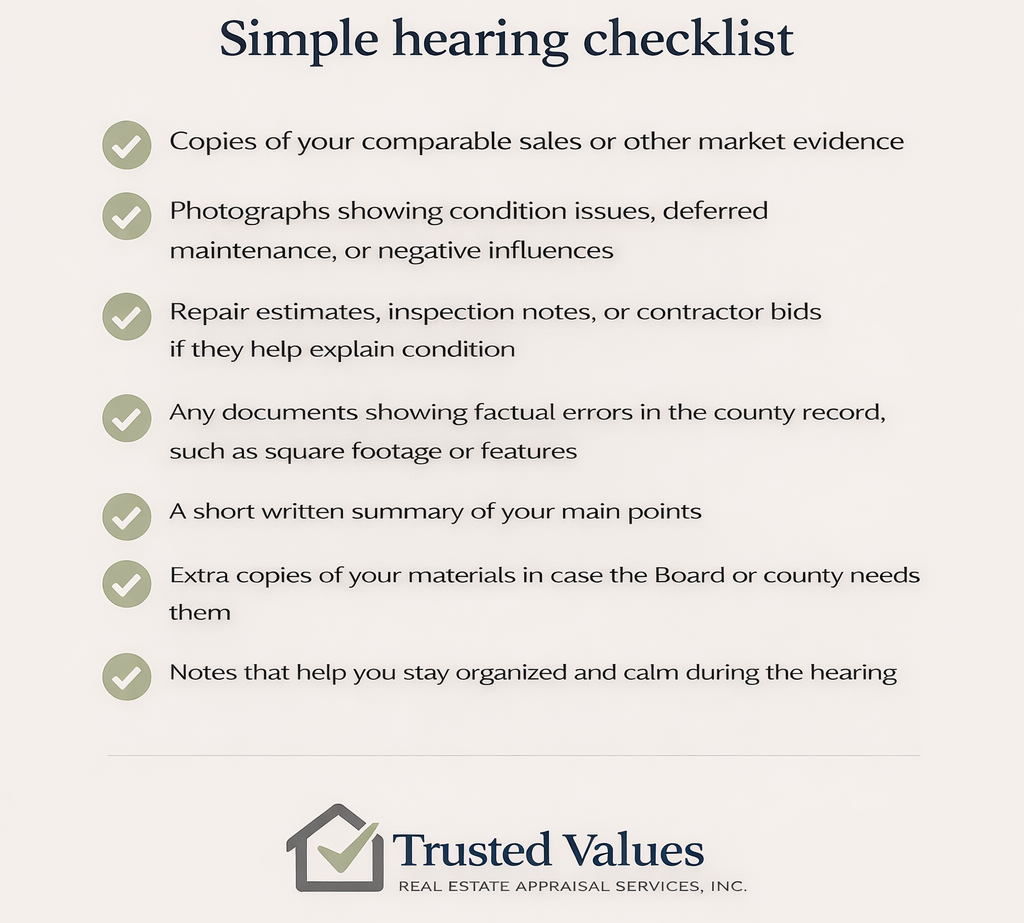
The strongest hearing presentations are usually organized, factual, and easy to follow. A homeowner does not need to sound like a lawyer. But it does help to arrive with a clear packet of information that supports the value being argued.
Comparable sales are often the backbone of a value appeal, but they are not the only useful evidence. Condition can matter. Location influences can matter. Errors in the county record can matter. The best mix of evidence depends on the property. Our related article “How to Check Your Property Value Before Filing a Tax Appeal” can help homeowners do a first review, and our evidence article explains in more detail what tends to support a property tax appeal most effectively.
What kinds of preparation usually help?
Preparation usually helps in very practical ways. First, organize your materials so the Board can follow them without guessing what you mean. Second, keep your explanation simple. Third, make sure your best points are easy to identify.
A calm, direct presentation often carries more weight than a complicated one. If you have three strong comparable sales, explain why those homes are genuinely similar to yours. If your home has deferred maintenance, show clear photos and explain how those issues affect marketability or buyer reaction. If the county’s record contains a factual error, point to the document that corrects it.
Homeowners are often surprised by how much credibility comes from being prepared and specific. The hearing is usually not won by sounding forceful. It is won by making the facts easier for the Board to understand.
What tends to hurt a case?
Focusing only on the tax bill: A BOE hearing is generally about value and related legal grounds, not simply frustration over how much tax is owed.
Bringing weak or poorly matched comparables: Nearby sales are not always good comps. Differences in size, condition, lot characteristics, renovations, or location influences can matter.
Relying too heavily on online estimates: Automated estimates can be interesting as a rough reference, but they are usually not as persuasive as well-explained comparable sales and property-specific evidence.
Showing up disorganized: A scattered stack of papers and an unclear explanation can make a valid case harder for the Board to follow.
Letting frustration take over: Most hearings are civil and structured. Staying calm usually helps you far more than trying to argue emotionally.
Missing procedural requirements: Counties may have deadlines or exchange rules for evidence and representation. Those details matter, even when the hearing atmosphere feels informal.
This is one reason many homeowners benefit from preparing earlier than they think they need to. Last-minute preparation often leads to preventable mistakes.
What happens after the hearing?
After the hearing, the Board issues a decision on the appeal. In many cases, the result is announced at or near the end of the hearing and then followed by a written decision. That written decision is important because it tells you what value the Board set, if any, and it usually begins the clock for any further appeal rights.
Sometimes the Board agrees with the homeowner in whole or in part. Sometimes it agrees with the county. Sometimes the outcome lands somewhere in between. What matters most is that the Board’s decision becomes an important reference point for what happens next.
If a homeowner remains dissatisfied after the BOE decision, Georgia law allows further appeal in certain circumstances. But many homeowners treat the BOE stage as the main practical review point because it is more accessible and less formal than later stages.
A brief note on Georgia’s two-year appeal freeze rule
One practical point deserves mention, even though it should not overshadow the rest of the hearing process. Georgia has an important rule often described as the two-year appeal freeze. In general terms, when a value is established through an appeal decision or written agreement, there may be limits on how much the county can increase that value for the next two tax years unless certain conditions change.
That can make an appeal more meaningful than it first appears, because the effect may carry beyond a single year. We cover the broader financial side of that idea in “Is a Property Tax Appeal Worth It? A Break-Even Guide for Homeowners,” and the freeze rule itself likely deserves a fuller article of its own.
When professional appraisal help may be useful
Some homeowners are comfortable handling a Board of Equalization hearing on their own. Others are not. There is nothing wrong with either approach. The right path depends on the property, the quality of the available evidence, and how confident the homeowner feels presenting a value case.
Professional appraisal help may be especially useful when the property is unusual, the comparable sales are not obvious, the county’s value appears difficult to challenge with simple public records alone, or the homeowner wants stronger valuation support at a more formal stage of the process. A credible, well-supported appraisal can help turn a general sense that a value is too high into a more clearly documented opinion of value.
Trusted Values is the public brand of Real Estate Appraisal Services, Inc. If you are preparing for a Georgia property tax appeal or an upcoming Board of Equalization hearing and need independent valuation support, our office may be able to help you determine whether a professional appraisal would be useful in your situation.
Final thought
For many homeowners, the hardest part of a Board of Equalization hearing is the uncertainty before it begins. Once you understand the basic structure, the process usually feels more manageable. It is a formal hearing, but it is not usually as intimidating as people imagine. In most cases, it is simply a structured opportunity to present facts, answer questions, and let the Board decide what value is better supported.
If you prepare carefully, focus on evidence, and keep the presentation calm and organized, you give yourself the best chance to be heard clearly.