
If you believe your Georgia property tax assessment may be too high, the next question is usually not whether you are frustrated. It is whether you have something concrete that helps support that belief.
That distinction matters. A property tax appeal is generally about value, not simply about how much taxes might be owed. In practical terms, that means the strongest appeal is usually built on facts that help show what the property would likely sell for in the market, not on general disagreement with the county’s number.
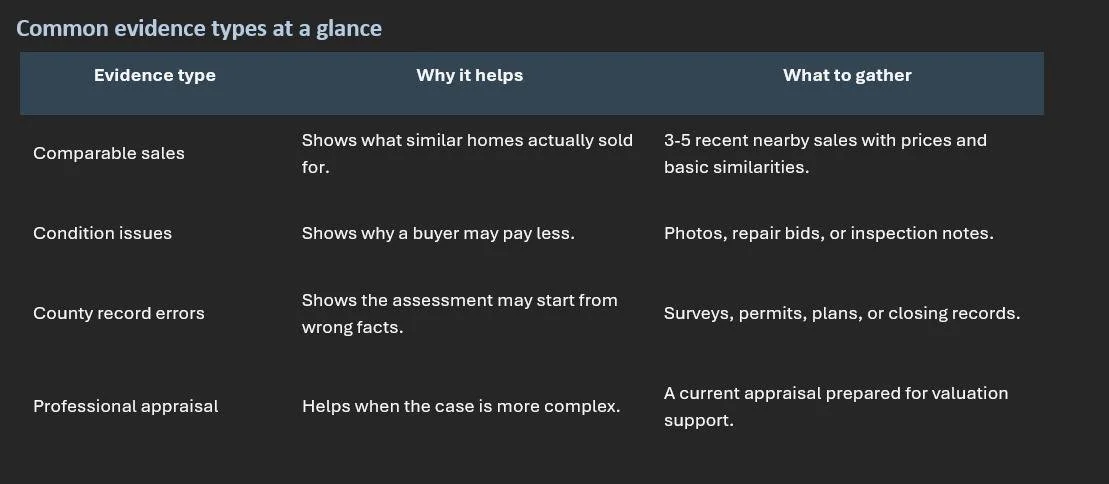
For most homeowners, the best evidence falls into a few familiar categories: recent comparable sales, documented condition issues, corrections to errors in county records, and in some cases a professional appraisal or other supporting documents. The point is not to overwhelm the county with paperwork. The point is to present information that is specific, credible, and tied to value.
This article is meant to explain what that looks like in plain English.
What usually makes evidence persuasive
A useful way to think about this is that strong evidence is usually objective, property-specific, and relevant to market value.
Objective means it is not just a feeling or a guess. Property-specific means it relates to your home, not just to the neighborhood in a broad sense. Relevant to market value means it helps answer the real question: what would a knowledgeable buyer likely pay for this property under normal market conditions?
When evidence checks those boxes, it tends to be much more helpful than general complaints, rough online estimates, or comparisons that are not truly comparable.
Comparable sales are often the backbone of the case
For most residential appeals, recent comparable sales are often the strongest place to start. Counties commonly rely on mass appraisal methods, which means they are working from broad market data across many properties at once. A homeowner’s job is to show where the county’s number may not match what similar homes actually sold for.
A good comparable sale is usually recent, nearby, and reasonably similar to the subject property in size, age, design, utility, and overall appeal. Perfect matches are rare, but the closer the comparison, the more useful the sale tends to be.
In practice, homeowners are often better off with a small set of solid comparables than a longer list of weak ones. Three to five well-chosen sales are usually easier to explain than a pile of scattered examples.
This is also where discipline matters. Not every lower-priced house is a helpful comp. If a sale involved a very different lot, condition, layout, or level of updating, the comparison can get weak quickly.
Condition issues and repair needs can matter
If the property has deferred maintenance or physical problems that would affect what a buyer would pay, that can be important evidence as well. Roof issues, foundation concerns, water intrusion, outdated interiors, damaged flooring, failing systems, or functional problems may all influence value.
The key is documentation. Clear photographs help. Repair estimates, contractor bids, inspection reports, or engineer reports can help even more when they connect the issue to a real-world cost or market reaction.
A homeowner does not need to dramatize the condition of the home. In fact, that usually hurts credibility. Calm, specific documentation tends to carry more weight than exaggeration.
Errors in county records should not be overlooked
Sometimes the problem is not the market at all. Sometimes the county is simply working from inaccurate facts. That can include incorrect square footage, room count, basement finish, lot size, quality level, or other property characteristics.
That is why it often makes sense to review the property record carefully before making broader arguments about value. If the county has the basic facts wrong, correcting those facts may be one of the clearest parts of the case.
Here again, documentation matters. Surveys, plans, permits, closing documents, photographs, and other reliable records are generally more helpful than informal estimates.
A homeowner can also request supporting county records
Georgia law allows property owners to request certain records and information related to the assessment. In plain terms, that can include material showing how the county reached its value and which comparable properties it relied on.
That information can be useful because it helps a homeowner see the county’s logic more clearly. Sometimes the county’s comparables are stronger than expected. Sometimes they are not. Either way, it gives the appeal a firmer factual footing.
This step is especially helpful when a homeowner wants to move beyond a general sense that the value feels high and into a more focused review of where the county’s analysis may have gone off track.
When a professional appraisal may make sense
Not every appeal requires a professional appraisal. Many homeowners can do a reasonable first review on their own. But there are situations where professional help may be worth considering.
That may be true when the value gap appears significant, when the property is unusual, when there are not many good comparable sales, or when condition or site issues are more complicated than a simple DIY review can capture.
A professional appraisal is not magic, but it can provide a structured opinion of value that is easier to defend when the facts are more nuanced.
What usually helps less than homeowners think
Some things feel persuasive to homeowners but usually do not do much to support a value appeal on their own.
A high tax bill is not the same thing as proof that the assessment is wrong. A large increase from the prior year is not, by itself, proof either. Automated online estimates can be useful as a very rough reference point, but they are not the same as property-specific evidence. And pointing to a neighbor’s assessment is usually much less helpful than pointing to actual sales.
A good rule of thumb is this: if the evidence does not help explain what your own property would likely sell for, it may not move the discussion very far.
A simple way to organize the evidence
Most homeowners do not need a complicated presentation. A clean and orderly packet is usually enough. That might include a short summary, a few strong comparable sales, photographs of relevant condition issues, supporting repair or inspection documents, and records correcting any factual errors in the county file.
The goal is clarity. A smaller set of organized evidence is usually more effective than a large stack of loosely related material.
Final thought
A property tax appeal does not have to begin with a fully formed expert case. But it usually should begin with something more concrete than a sense that the number feels too high.
For many homeowners, the best starting point is simple: check the county’s facts, review a few meaningful comparable sales, document any real condition issues, and then decide whether the case looks straightforward or whether it may need more professional support.
In other words, facts usually help more than frustration.